

A four-strand challah looks impressive, but once you learn the repeating pattern it's much easier than it appears. Learn how to braid both a classic straight loaf and a woven round challah with step-by-step photos, a video, and plenty of tips so you'll be turning out bakery-worthy challahs in no time!
Jump to:
- Quick Braiding Guide ✨
- Why these instructions work
- Before you start
- How to make the challah ropes
- How to braid a straight four-strand challah
- How to braid a round four-strand challah
- Troubleshooting challah braiding
- Explore more challah braiding tutorials
- Questions asked and answered
- More shaped bread recipes to try
- Recipe
- Comments
Quick Braiding Guide ✨
Learn two four-strand challah braids: Follow step-by-step instructions for both a straight bakery-style challah and a woven round challah for Rosh Hashanah using any homemade challah dough.
Designed for success: Written braid patterns, detailed photos, a video demonstration, and troubleshooting tips help you master the weave with confidence.
Time to braid: About 15 to 20 minutes (after dough is prepared) • Final Rise: 30 to 45 minutes • Bake according to your challah dough recipe.
Difficulty: ⭐⭐⭐ Medium. The braid looks impressive, and the repeating pattern becomes easy after a little practice.
Works with: Any well-rested challah dough recipe • Great for Shabbat, holidays, and special occasions.
👉 Follow the detailed braiding instructions and troubleshooting tips below to create beautiful four-strand challahs that bake up with clean definition and a bakery-quality finish.
SUMMARIZE & SAVE THIS CONTENT ON
Why these instructions work
- Starts with well-shaped dough ropes for a smoother, more even braid
- No complicated diagrams to memorize
- Photos and video guide you every step
- Simple tips for neat, even braids
- Gives you the confidence to braid beautiful challah every time
Whether it's straight, round, squared off, or in a wreath, bread comes in a variety of shapes. Most types of bread aren't associated with a specific shape, but challah, a Jewish egg bread similar to brioche, definitely is one of those. It's instantly recognizable.
A four-strand challah is a traditional Jewish egg bread woven from four equal strands of dough into either a straight or round loaf. It's commonly served for Shabbat, Rosh Hashanah, and other Jewish celebrations. And of course, it's great for making french toast!
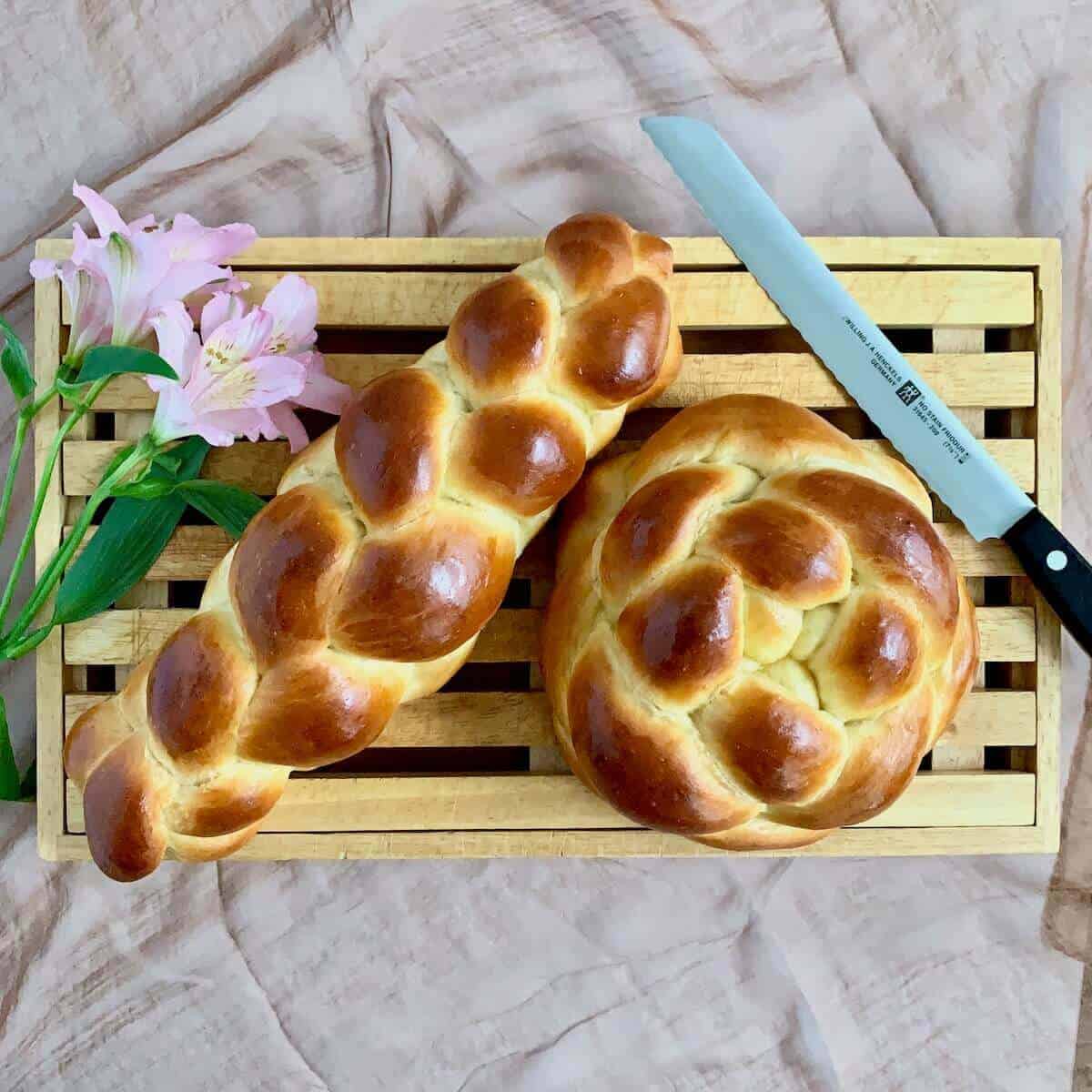
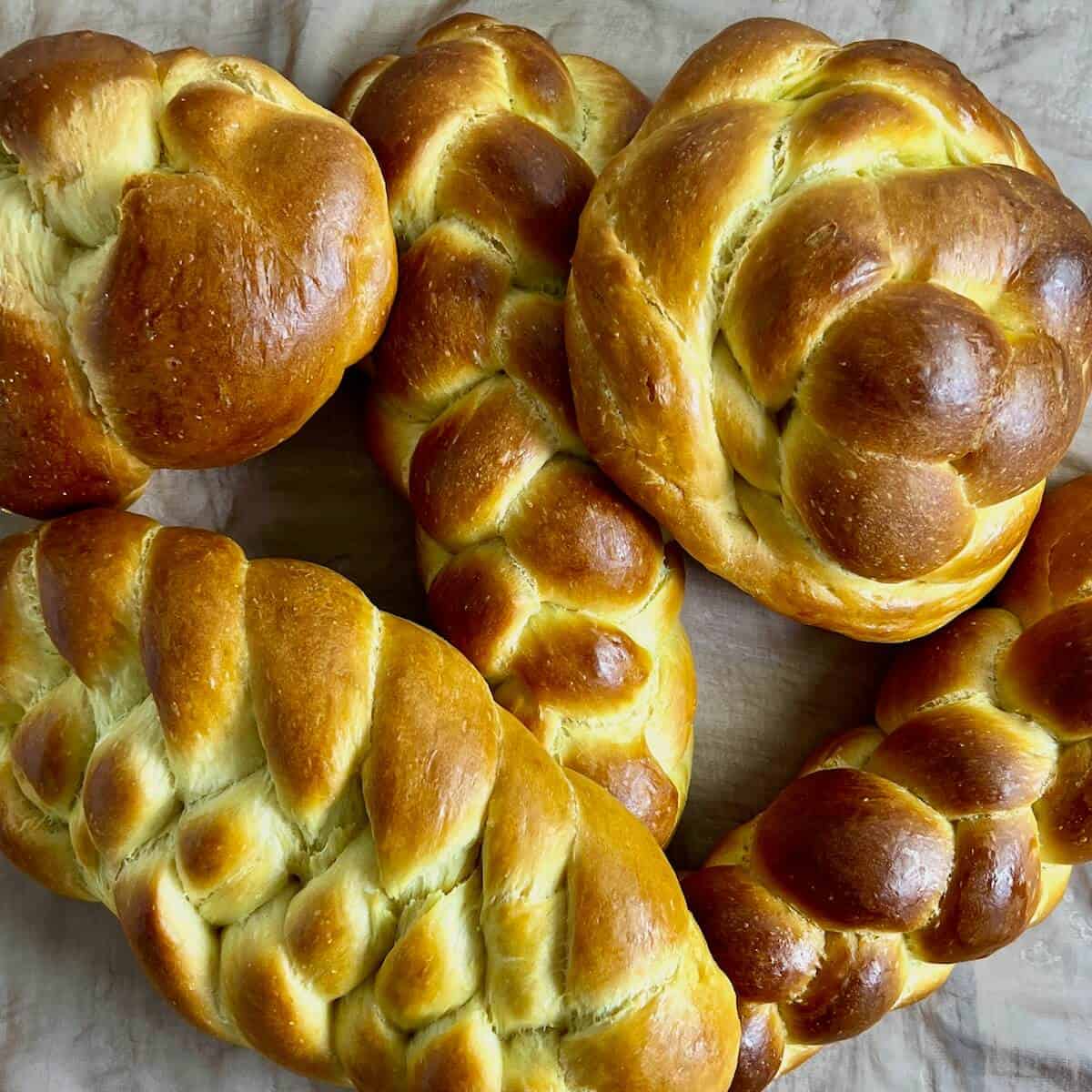
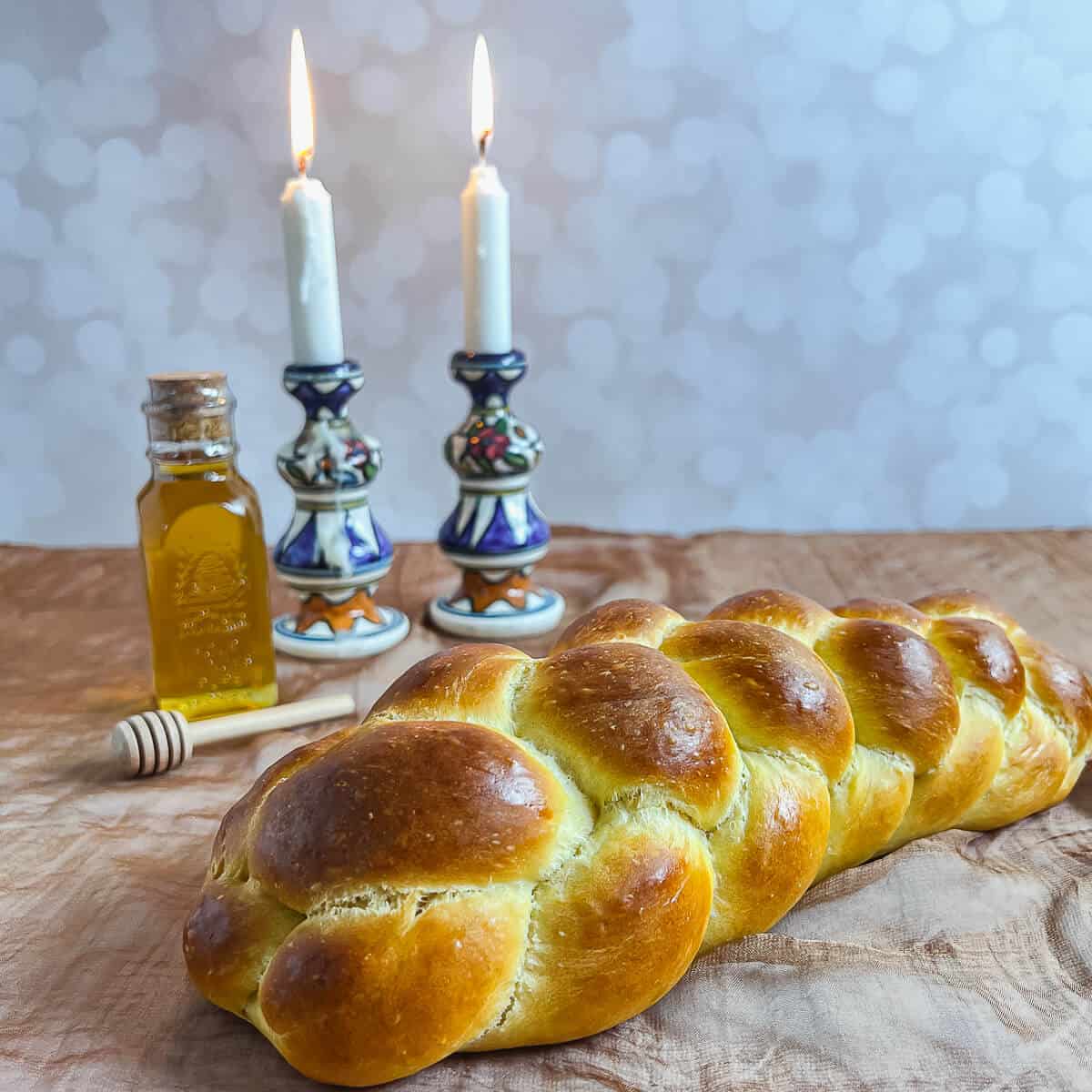
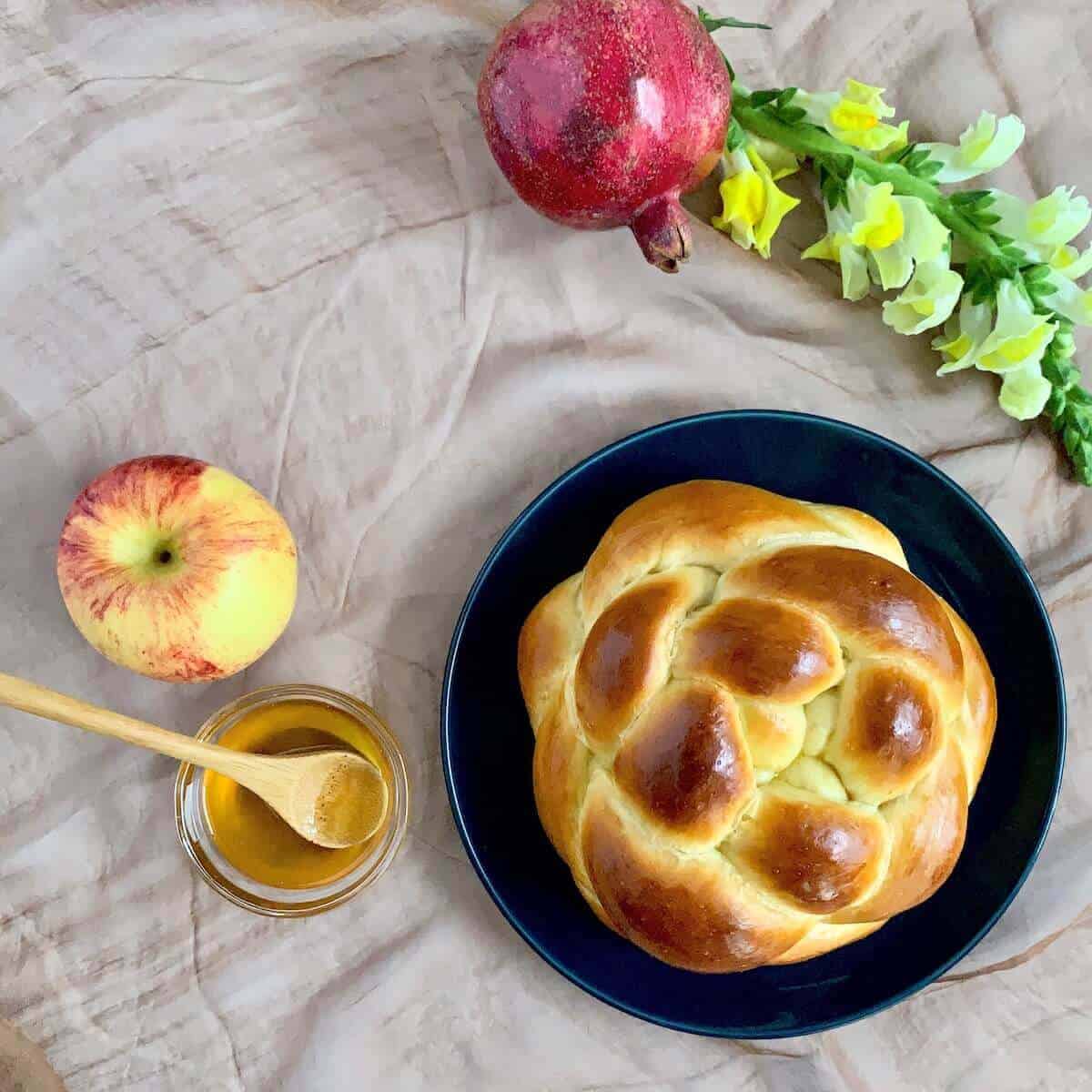
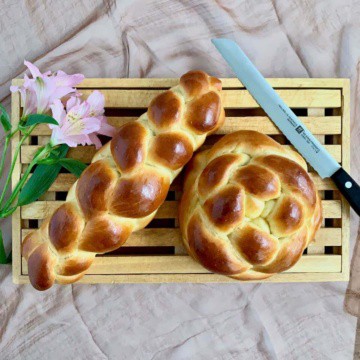
This finished straight four strand challah looks beautiful, with a shiny exterior and a soft interior. The round four strand challah looks impressive, but is really quite easy to weave.
Practice with patience and soon you'll master the patterns for shaping challah dough. And if your first braid isn't perfectly even, don't worry - every loaf gets easier, and even imperfectly braided challah tastes delicious.
Impress your family and friends, and have the satisfaction you plaited like a pro with a challah bread worthy of a bakery. Happy braiding!
Before you start
These braiding instructions work with any challah dough recipe. If you haven't made the dough yet, start with my Best Challah Bread recipe. Once the dough has completed its first rise, come back here to learn how to shape it into a beautiful four-strand braid.
How to make the challah ropes
Rolling the risen dough into smooth ropes is perhaps the most challenging part of the process, especially if you're braiding larger numbers of strands.
Before you start rolling, here are a few tips to keep in mind:
- Use lightly floured hands if the dough is sticking to them
- Don't over-flour the counter (you may not even need flour at all)
- Keep unshaped dough balls covered
- Aim for even rope thickness before tapering the ends
Make the ropes
- Divide the dough evenly by weight for uniform strands: Portion out the number of pieces you'll need for your braid, cutting it with a bench scraper or knife. For the best accuracy, weigh the total amount of your dough using a kitchen scale and divide that number by the number of strands you need. Then portion the pieces to that weight.
- Shape each portion into a ball, then roll into a short oval: As you go, roll each portion into a ball, then flatten and roll it up into an oval (about the size of a small potato).
- Rest the dough for 20 minutes to relax the gluten: Keep the balls covered with plastic wrap (to keep from drying out) and let them rest. This rest will help the gluten to relax so the final rope won't be as inclined to shrink back as you roll it out.
- Roll from the center outward, tapering the ends: Starting in the middle of the oval, start to roll and stretch the dough using both hands cupped over the rope. As the rope gets to your desired length, press down on the ends to taper them to a point.
The length of each strand will depend on the number of portions you have. Keep in mind that the thinner the strand, the longer (and thinner) the braided challah will be. Keeping the strands thicker will result in a shorter (and thicker) challah.
How to braid a straight four-strand challah
Straight four-strand braids are a little trickier than a basic 3-strand braid, but the technique isn't hard to master.
Pattern summary: Move the outer strand across once, then repeat a two-step pattern of placing the second strand over and the top strand into the center.
With a little practice, your challah will look like it came straight from the bakery! Just remember to braid firmly enough to hold the shape together, but loosely enough that the dough still has room to expand during the final rise.
Step 1
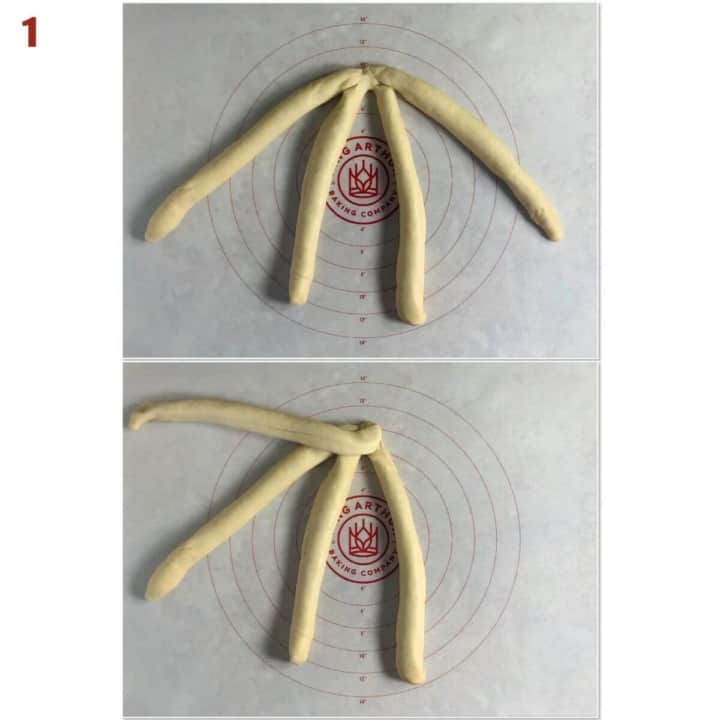
Shape 4 dough portions into long ropes. Lay all the ropes side by side on a lightly floured surface and pinch them together at the top.
Take the topmost right strand and place it on the opposite side. You're only going to do this step once (photo 1).
Step 2
Take the second from the top left strand and place it on the opposite side. Take the topmost left strand and place it in the middle of the two remaining strands (photo 2).

Step 3
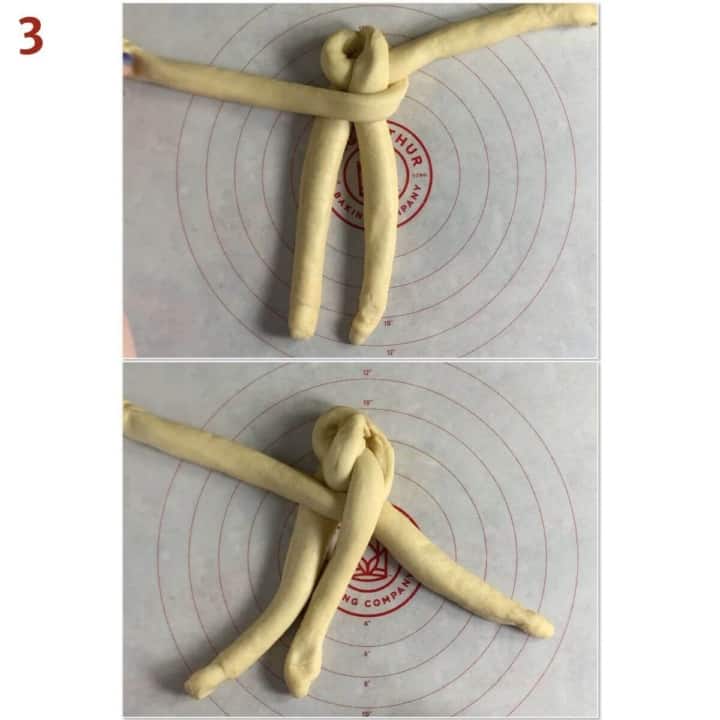
Take the second from the top right strand and place it on the opposite side. Take the topmost right strand and place it in the middle of the two remaining strands (photo 3).
Keep the ropes the same length
If one rope becomes noticeably longer while braiding, gently compress it toward the center before continuing instead of stretching the shorter strands.
Step 4
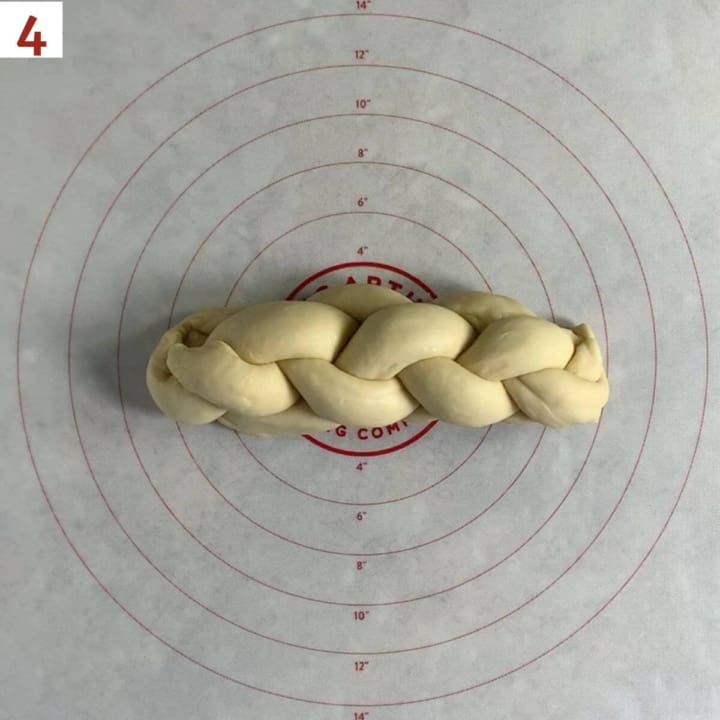
Repeat steps 2 and 3 until all the dough is braided.
Tuck the ends of the loaf underneath on both ends to give a neat finish. Adjust the braid ends and sides with your hands to make everything even (photo 4).
How to braid a round four-strand challah
There are many ways to make a round challah. The easiest of course is to make a long rope, then coil it up. Easy, but not as pretty. The next option is to make a three-strand braid, then coil it up into a spiral.
Let's take our round challah to the next level with a four-strand woven round challah.
Pattern summary: Arrange the dough in a cross, then weave by alternating counter-clockwise and clockwise passes, tucking the ends underneath to form a woven circle.
Step 1
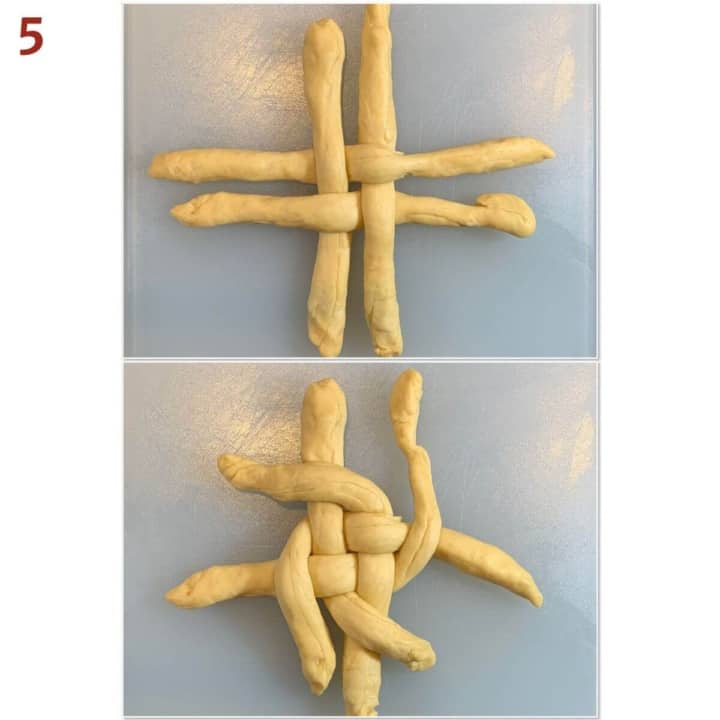
Shape 4 dough portions into long ropes. Lay two strands next to each other horizontally. Lay the remaining two strands next to each other vertically on top of the first two.
Take the right vertical strand and weave it under the upper horizontal strand. Take the left vertical strand and weave it under the lower horizontal strand (you now have a pattern akin to a tic-tac-toe board). Push all the strands tightly together in the middle so there's no space between them, and separate the ends so you'll have room to start weaving.
Starting with the lower left vertical strand, place it over the strand next to it on the right. Repeat around the circle, going counter-clockwise a total of 4 times (photo 5).
Step 2
Now do the same thing starting with the lower right vertical strand, placing the strand over its neighbor on the left, going around the circle clockwise.
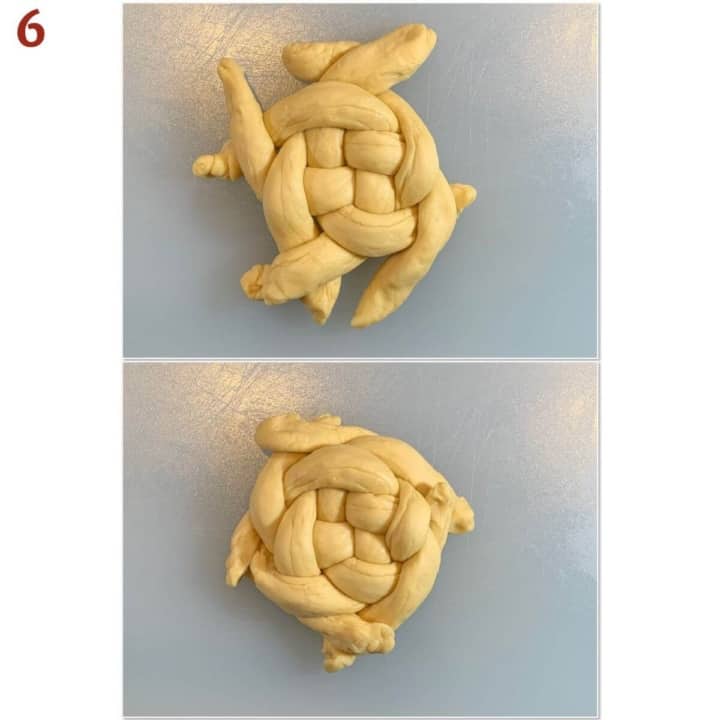
Repeat steps 1 and 2, traveling counter-clockwise, then clockwise. By now the strands will be too short to continue. (photo 6).
Step 3
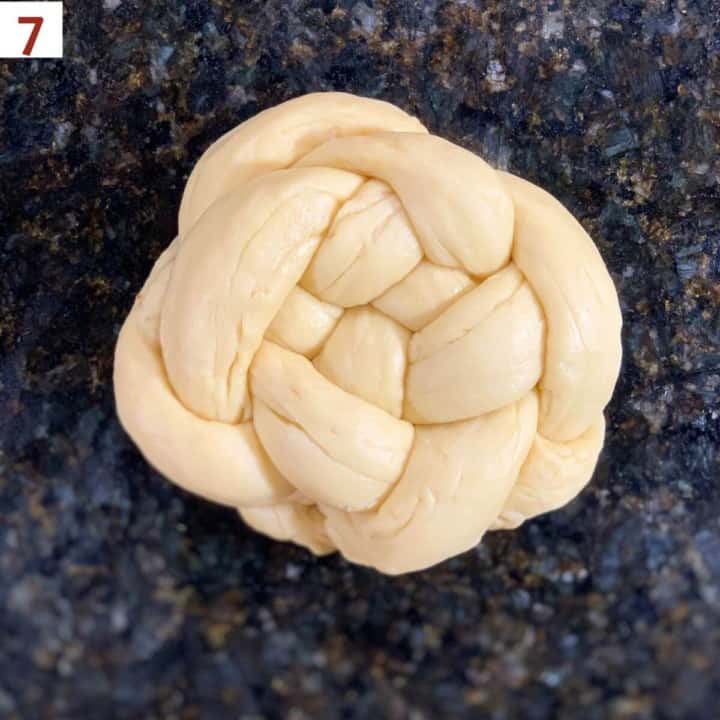
Tuck the ends under and adjust the woven round mass into a circle (photo 7).
Make sure both ends are secure
When you start the braid, you tightly pinch the ends of the strands together. After you've come to the end of the strands, you also pinch them together, then tuck both ends under to keep them from coming apart while baking. You'll want to pay special attention to this step.
Sometimes despite your best efforts, the ends will come apart while the challah is baking. I call these lobster claws, and while the challah won't look quite as neat, it will still taste fantastic.
Rest and bake the challah
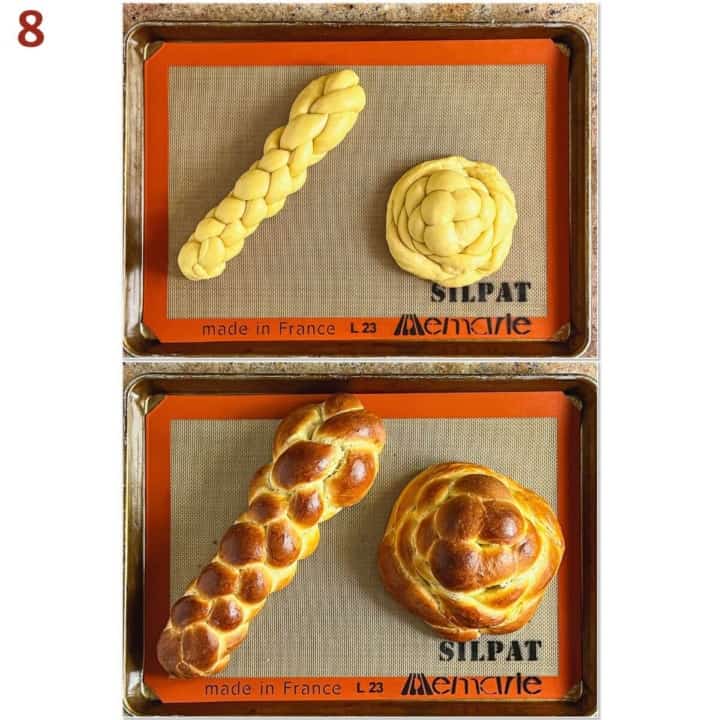
Continuing with the challah recipe (regardless of the shape), line a half sheet baking pan with a Silpat silicone mat or parchment paper. Transfer the shaped dough to the baking pan, then cover with greased plastic wrap. Let the shaped dough rise for 45 minutes in a warm place.
Brush the dough with an egg beaten with 1 tablespoon of water, then sprinkle on any desired toppings. Bake at 350˚F for 25 to 35 minutes, rotating the pan front to back halfway through the baking time.
When the loaf is golden brown and it sounds hollow when tapped on the bottom (or reads 190°F on a digital thermometer), remove it from the oven and cool on a wire rack (photo 8).
Troubleshooting challah braiding
If your challah didn't hold its beautiful braided shape, one of these common issues may be the culprit:
- The strands didn't have enough tension: If the dough wasn't fully proofed before shaping, the ropes can spring back as you roll them, making it harder for the braid to hold its definition.
👉 Fix: Let the dough complete its first rise until doubled in size. It should slowly spring back when lightly pressed with a fingertip. - The dough kept shrinking while you rolled the ropes: This usually means the gluten needs more time to relax.
👉 Fix: Cover the dough pieces and let them rest for another 10 to 15 minutes before rolling again. - The braid came apart during the second rise: If the ends aren't secured well, the strands can separate as the dough expands.
👉 Fix: Pinch the strands together firmly at both ends and tuck the ends underneath the loaf. - The challah over-proofed after shaping: If the shaped loaf rests too long, the gluten network becomes over-stretched and can't support the braid during baking.
👉 Fix: Let the braided loaf rise for about 30 to 45 minutes while the oven preheats. It should look puffy but not doubled in size. - Too much egg wash pooled between the strands: A heavy coating can soften the creases, making the braid less defined after baking.
👉 Fix: Brush on a thin, even coat, avoiding excess egg wash in the grooves.
Explore more challah braiding tutorials
A braided challah, all shiny and golden brown, is a work of art as well as a delicious bread. Slice it neatly, or use the bumps from the braids to tear off a piece!
Ready to learn another challah braid? Here's a quick comparison to help you choose your next tutorial.
| Tutorial | Includes | Best For | Difficulty |
| 3-Strand Challah | Straight & Round | Everyday baking and learning the basics | ⭐ Easy |
| 4-Strand Challah | Straight & Round | Decorative loaves with a fuller braid | ⭐⭐ Medium |
| 6-Strand Challah | Straight & Flat | Traditional bakery-style challah | ⭐⭐⭐ Medium |
| 8-Strand Challah | Straight & Round | Special occasions and holiday centerpieces | ⭐⭐⭐⭐ Advanced |
Questions asked and answered
Here are some questions you might have...
Used for Shabbat (the Jewish Sabbath), Rosh Hashanah (the Jewish New Year), or for special occasions, challah's special shape holds traditional meanings.
The internet abounds with websites explaining the many different reasons why braiding challah as an oblong shape is used on the Sabbath and other special occasions.
Those reasons vary based on how observant the individual is. Some sites go deep into Jewish law (having to do with the rituals of the ancient temple). Others look to a more biblical meaning (representing manna from heaven). Still others go for a more secular meaning (creating a shaped bread that can be distinguished from ordinary bread, thus making it safe to eat for the Shabbat meal).
In addition, the round challah used on Rosh Hashanah symbolizes the circular nature of time itself (one year ends, another starts), but even that simple explanation has deeper meanings for people.
Sure! This braiding method is good for any well-kneaded and rested challah dough. The dough's hydration (which affects how dry the dough feels after resting) will affect how the dough will respond to braiding, not the patterning itself.
That's a resounding yes, using the technique for braiding a straight 4-strand challah described above.
A 6-strand braid uses the same technique as the four-strand braid. It's just you have to make sure when you place the strand in the middle, you have 2 strands on either side instead of 1.
With an 8-strand challah when you place the strand in the middle, you will have 3 strands on either side instead of 1.
For a different look entirely, you can also use my instructions for braiding an 8-strand challah.
You can also make a round challah with eight strands for a double weave pattern, using the same technique as the four strand round challah described above. Here's an example of a double weave challah before and after baking.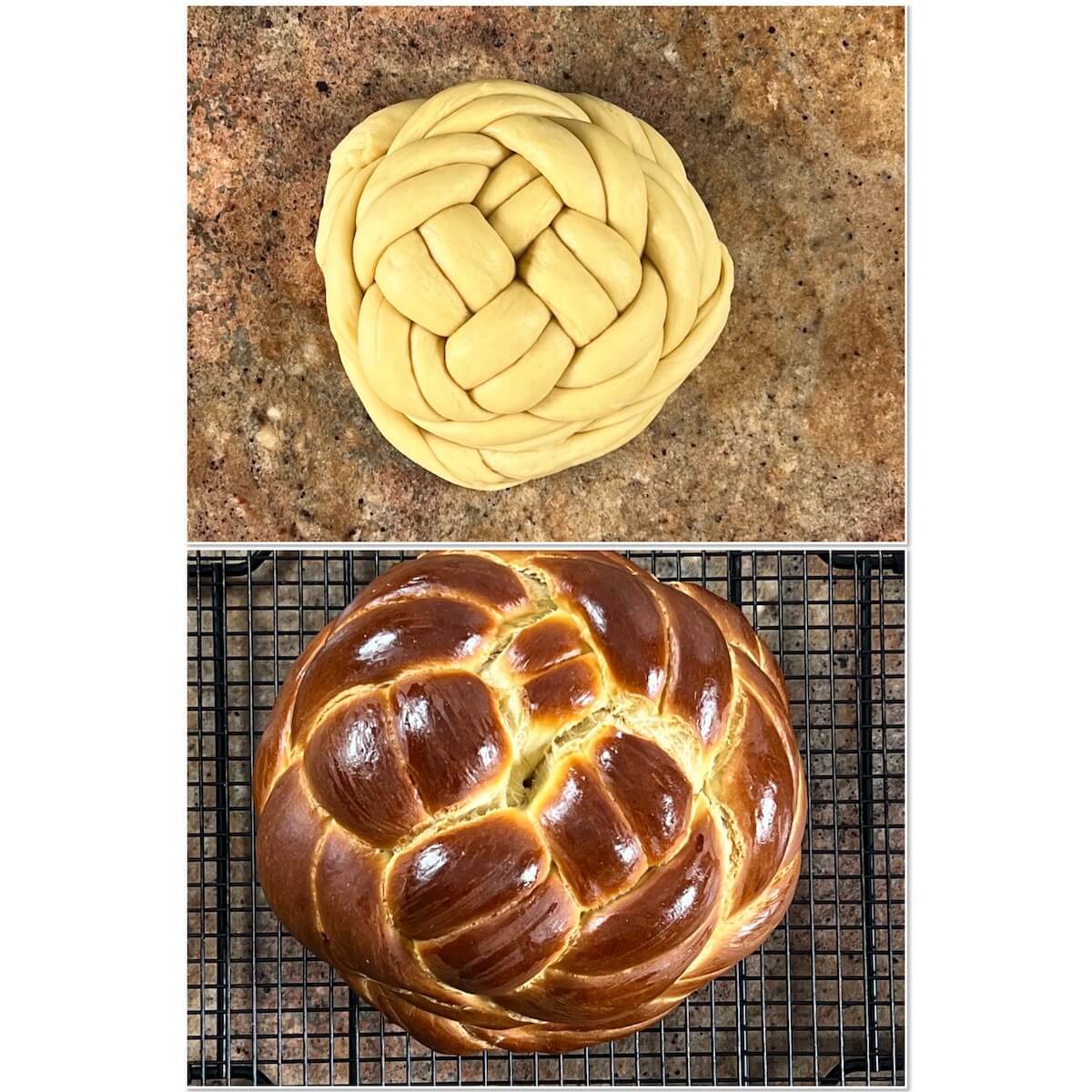
Didn't find the answer you're looking for?
Ask AI to answer for this specific recipe:
Disclaimer: I am not responsible for the quality of AI information

I hope you like this recipe! Let me know if you have any questions, and don't forget to leave a comment and rating. Thanks!
Slainté! L'chaim! Cheers!
- Tammy
More shaped bread recipes to try

Recipe
How to Braid a 4-Strand Challah (Straight & Round)
Equipment
- kitchen scale recommended
Ingredients
- 1 recipe homemade challah dough, after the first rise
- 1 large egg, plus 1 tablespoon water, for egg wash
- toppings, optional
Instructions
- These braiding instructions begin after your challah dough has completed its first rise. If you haven't made the dough yet, use your favorite challah recipe (or my Best Challah Bread) before starting the braid.
- Portion out 4 equal pieces of dough, cutting it with a bench scraper or knife (for the best accuracy, weigh the dough with a kitchen scale). Shape each piece into a long rope.
For a straight challah
- Step 1: Lay all the ropes side by side on a lightly floured surface and pinch them together at the top. Take the topmost right strand and place it on the opposite side. You're only going to do this step once.
- Step 2: Take the second from the top left strand and place it on the opposite side. Take the topmost left strand and place it in the middle of the two remaining strands. This is the first step of the repeating pattern.
- Step 3: Take the second from the top right strand and place it on the opposite side. Take the topmost right strand and place it in the middle of the two remaining strands. This is the second step of the repeating pattern.
- Repeat steps 2 and 3 until all the dough is braided.
- Tuck the ends of the loaf underneath on both ends to give a neat finish. Adjust the braid ends and sides with your hands to make everything even.
For a round challah
- Step 1: Lay two strands next to each other horizontally. Lay the remaining two strands next to each other vertically on top of the first two.
- Step 2: Take the right vertical strand and weave it under the upper horizontal strand. Take the left vertical strand and weave it under the lower horizontal strand (you now have a pattern akin to a tic-tac-toe board).Push all the strands tightly together in the middle so there's no space between them, and separate the ends so you'll have room to start weaving.
- Step 3: Starting with the lower left vertical strand, place it over the strand next to it on the right. Repeat around the circle, going counter-clockwise a total of 4 times.
- Step 4: Now do the same thing starting with the lower right vertical strand, placing the strand over its neighbor on the left, going around the circle clockwise.
- Step 5: Repeat steps 3 and 4, traveling counter-clockwise, then clockwise. By now the strands will be too short to continue.
- Tuck the ends under and adjust the woven round mass into a circle.
Rest and bake the challah
- Line a half sheet baking pan with a Silpat silicone mat or parchment paper. Transfer the shaped dough to the baking pan, then cover with greased plastic wrap.
- Let the shaped dough rise for 45 minutes in a warm place. Preheat the oven to 350 °F.
- For the egg wash, whisk together 1 large egg with 1 tablespoon water. Brush the dough with the egg wash, then sprinkle on any desired toppings.
- Bake the dough for 25 to 35 minutes, rotating the pan front to back halfway through the baking time. When the loaf is golden brown and it sounds hollow when tapped on the bottom (or reads 190 °F on a digital thermometer), remove it from the oven and cool on a wire rack.
- Let the challah cool slightly before slicing or tearing into it. Enjoy!





Comments
No Comments